Twenty Mule Team
In 1978, the Newcomen Society of North America inducted Fuller E. Callaway Jr. as a new member at a special ceremony in Atlanta, Georgia. His inclusion into this prestigious organization that recognized excellence in business was remarkable because he was the third member of the same family to be granted membership. Both his father and brother, Cason, also received this award, but their recognition was posthumous, making Fuller the only one able to offer acceptance remarks. He made the following observation during his brief comments,
“I can assure you that I am not like the wagon driver, who long ago, drove a 20-mule team for so many years that he finally reached the point where he thought that it was he who was pulling the wagon. I fully realize that the success of Callaway Foundation, Inc. and the other organizations with which I have been connected should not be credited to me alone, but should be shared with all of the fine people on the various teams which have really been pulling the wagon – while I sat in the driver’s seat and rode!”
A grateful Fuller then said time would not permit him to thank all those who should share the honor. The list would include trustees, directors, attorneys, engineers, customers, office workers, and thousands of mill workers noting: “…without whom we would have gotten nowhere.”
While almost 50 years have passed since that address, it’s worth reflecting on a few of the loyal business associates and friends who helped him achieve such success, right here in LaGrange. Fuller surrounded himself with dozens of leaders who specialized in different areas of the textile business, but here the list is whittled down to a handful. Some long-time associates date back to when his father opened the first mill, while others are more recent additions. As was common at the time, almost all of the early leaders are white men, as it would be several decades before other groups were represented in leadership positions. His emphasis on thanking the team reflects how he valued the contributions of everyone. He was not above them, he was part of them, a true lesson in humility which we sorely need more of today. We hope you enjoy learning a little bit about some of the mule team members that Fuller would have certainly thanked. ~CBW
Chilton Willis Coleman is the namesake of the old Coleman Library that was originally part of the Callaway Education Association (CEA). After graduating from Mercer University, he joined the Callaway companies in 1916 and continued until his untimely death in 1946. During his thirty years of service, he administered the welfare and education efforts of the business and directed the CEA after it was formed in 1943. A memorial to Coleman in 1946 described his brilliant mind, genial disposition, ready wit, and unselfish devotion to people needing assistance. Nine years after his death, the newly constructed library was named in his memory. The dedication program that day included the following text: “His warm affection for the people of our community and his love of books made a library one of his favorite dreams.” An avid collector, the library included over 3,000 volumes that were donated from his estate, including many religious books. Coleman, who never married, also ran a lodging house for mill workers.
Arthur Brannon Edge Jr., known locally as “Skin,” was central to the success of Callaway Mills and had the complete confidence of Fuller. They met at Georgia Tech, where both majored in textile engineering, and graduated in 1926. Upon completing his degree, Skin began working for the Callaway group of companies and worked his way up over the years. Their relationship was so close that Fuller was best man when Skin married Florence West in 1930. He became the first non-Callaway president of the company when Fuller retired in 1945, keeping that role until 1961, and then continuing as a vice-president for seven more years. Away from work, their two families spent many happy times together. Fuller, an amateur artist, even painted a picture of Edge’s house and gave it to him as a personal gift in 1954. Skin and Florence had two sons (Arthur III and Edward) and a daughter, Emily. For many years, his name graced the Intercollegiate Athletic Center at Georgia Tech.
Hatton Lovejoy was a longtime legal advisor for Fuller Sr, Cason, Fuller Jr, and Callaway Mills. He completed his law degree at the University of Georgia in 1897 and also played both football and baseball there as a star athlete. After graduating, he established his practice in LaGrange and went on to become highly respected for his legal expertise. Lovejoy helped Fuller Jr establish the charter for the Callaway Community Foundation in 1943. He was very active in community affairs, serving as a member of the Georgia House of Representatives, a trustee of LaGrange College, and numerous other organizations. In the legal world, he was elected as president of the Georgia Bar Association and sat on the State Constitutional Revision Committee in 1943-1944. Lovejoy and his wife Lora had five children. By the time of his death in 1964, he’d provided counsel to the Callaway companies for 61 years. Just three months before his passing, he wrote to Fuller and Alice: “I am not enough of a scholar to write you how much you both mean to me in my life. Both of you are never-failing in your thoughtfulness to me. Fuller’s cigars and Alice’s camellia bush are simply perfect examples. I count your friendship as one of most precious treasures in my life. May the lord bless you, is my prayer.” It was the last letter they ever received from Lovejoy. The courtroom at the University of Georgia School of Law and a local college scholarship program are named in his honor.
Samuel Meadows Turner from Montezuma, Georgia, joined the engineering department of Callaway Mills in 1934, five years after he graduated from Georgia Tech with a degree in architecture. He soon learned that he shared a common interest with Fuller Jr, who was fascinated with architecture. Fuller engaged Turner to design numerous buildings, including these three prominent commissions: a new office for the Callaway Community Foundation in 1948, the Coleman Library in 1955, and the Callaway Mills Administrative building in 1961. Turner buildings are easily recognized by their signature brick construction, classical design, and limestone accents and columns. His designs reflect Fuller’s emphasis on quality and were built to last. He received his 25-year service pin in 1959 and continued to work for the Callaway’s into the 1960s.
William Henry Turner Jr. began working for the Callaway companies in 1911 and continued employment with them until 1947. Originally from Greensboro, NC, he relocated to Georgia to work at a cotton duck mill in Hogansville but then became superintendent of Unity Mill. At about that same time, he married Hazel Vorus of Atlanta. During his long tenure, he specialized as a purchasing officer and became a director of the company. Fuller greatly trusted Turner and invited him to be an incorporator and trustee of the Callaway Foundation in 1943, a role he kept until his death in 1962. His active association with community affairs included ten years on the LaGrange City Council and four years as a County Commissioner. He and his wife raised three daughters. When he passed away, Fuller praised him for his: “unswerving honesty, dependability, fairness, and sound judgement.”
|
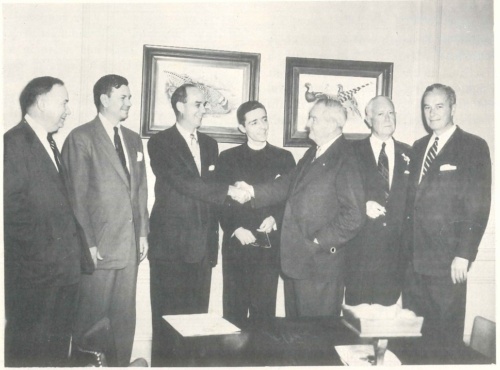
While we don’t currently have a picture of Fuller Jr.’s Newcomen Society address, the Callaway Beacon published this image from the 1954 meeting, at which Arthur B. Edge Jr. honored Fuller Callaway Sr. |
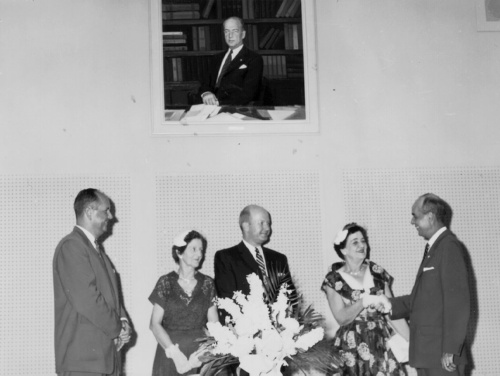
Arthur B. Edge (far right) is pictured standing under a portrait of Chilton W. Coleman with members of the Coleman family at the library dedication in 1955. |
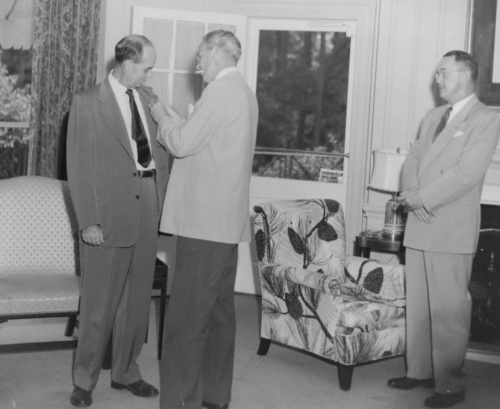
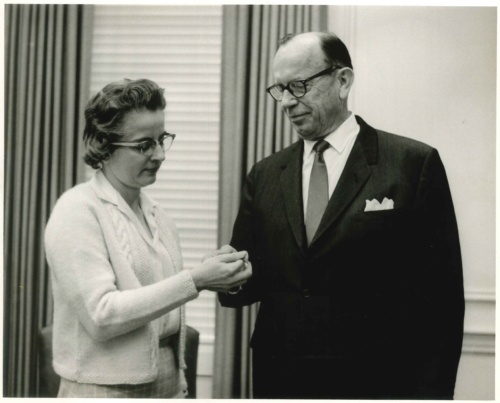
Fuller Jr. presented Arthur B. Edge with his 25-year service award in 1951. |
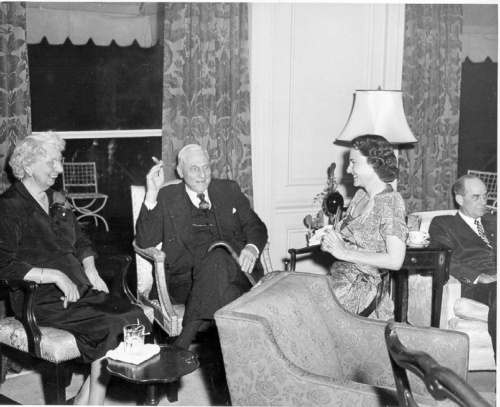
Madeline Carroll, Hatton Lovejoy, Alice Callaway, and A. B. Edge Jr. pictured socializing at the Callaway Mills Guest House. |
Samuel Turner (right) pictured with draftsman Katherine Cook. |