Something Worth Remembering
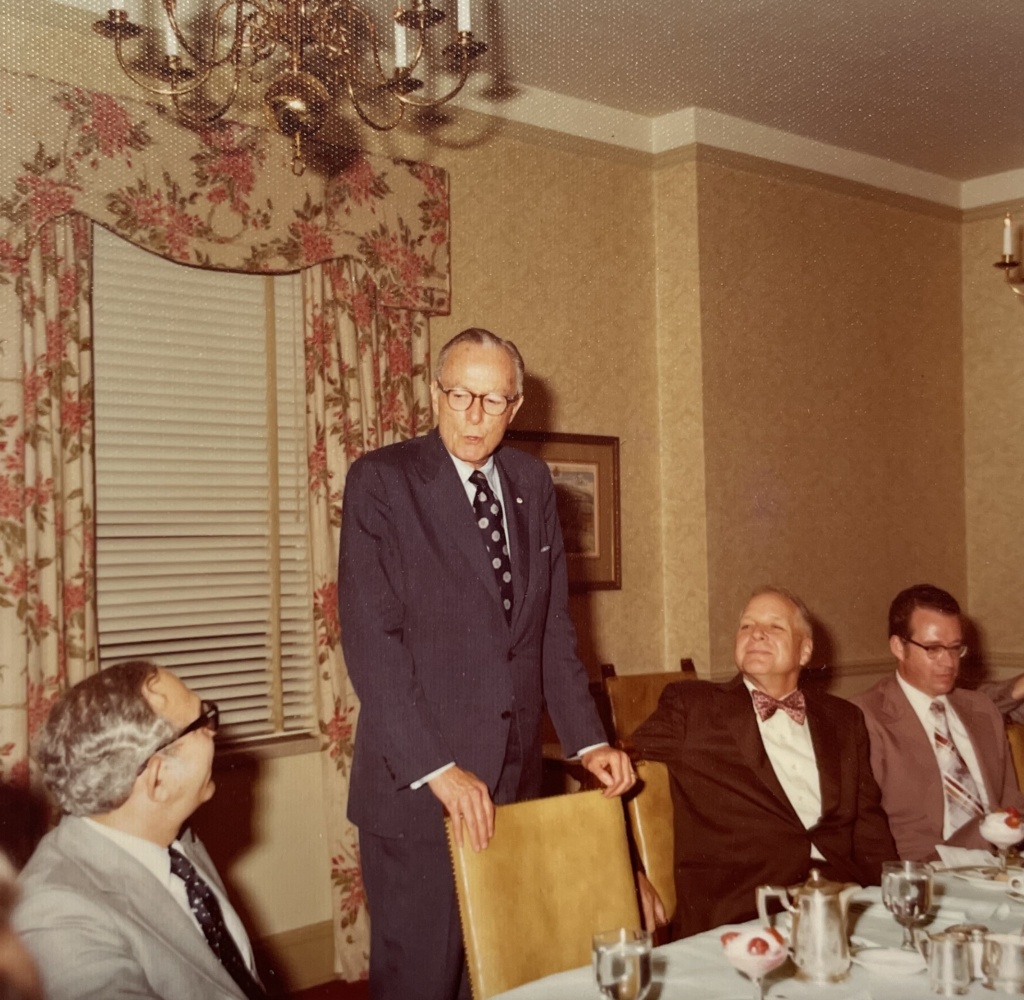
“People have asked me, from time to time, for the secret of our success…perhaps more important that any others, we have been blessed with a great deal of luck.”
– Fuller E. Callaway Jr., 1978
Because of his roles as business executive, community leader, and respected citizen, Fuller E. Callaway Jr. was frequently asked to talk to a wide variety of groups. He delivered dozens of presentations to students, church groups, civic clubs, and business associates. The breadth of his topics was amazing and included: world travel, textiles, business, military, ethics, religion, economics, dedications, and even inspiration. On one occasion, while serving in the Georgia State Guard, he was even invited to deliver a radio address.
Thanks to a family tendency toward preserving and archiving almost everything, I was fortunately able to take a peek back in time and look at notes from speeches Fuller Jr. made between 1933 and 1983. Because they span 50 years, they are an amazing treasure trove for a 20th century history buff such as me. I perused through the stacks of documents looking for interesting observations, insightful thoughts, and inspirational reflections. Below are some of my favorites. I hope you enjoy this sampling of ideas from one of LaGrange’s favorite sons.
A Few Beliefs
Many of Fuller Jr’s beliefs originated from his parents. The business values he learned from his father, fused with his strong Christian upbringing, resulted in a profound interest in helping his community.
During a speech to the Sons of the American Legion in 1940, he spoke about thrift: “So from the standpoint of good citizenship we should save to provide capital, to make life easier and more pleasant for our fellow citizens.” He went on to argue that dollars should be saved because: 1) we will need it worse later, 2) it will earn for us, and 3) it will build character through self-denial and qualify us to handle other people’s money for them.
On the more personal side, while addressing the First Baptist Church in 1946, he reminded everybody that they had a spiritual responsibility, saying: “Each individual has equal responsibility in this…the reward is high both here and in heaven. There is no other satisfaction (next to being yourself personally saved) which compares with the satisfaction and happiness which comes from having a part in leading someone to Christ.”
In 1982, as he was growing older, Fuller Jr. spoke at Morris Brown College, where he was honored with their “Man of Year” award. He shared this story from his youth related to charity.
“For shining my father’s shoes every night, he paid me ten cents a week, with the understanding that I would put ten percent, or one penny, in the plate at Sunday School, and that I would save one penny. That left me eight cents per week to throw away on luxuries like fruit and candy! My mother and father always tithed their income, and they expected me to do likewise. My father said that 10% of your income belonged to the Lord and that you were only paying your just debts when you tithed. He said that only the part of your contribution which exceeded 10% of your income could be considered free-will gifts.”
Humor
Fuller Jr. regularly incorporated humor into his talks. He addressed the 1941 LaGrange High School graduating class with a funny story.
“I was invited not long ago to teach a class in economics by a professor who is a friend of mine and who was called out of town. Since I was in the position of teaching a subject that I didn’t know much about, I decided to just ask a question. Having read about these new-fangled thought questions, I decided to start off with one of them, so I asked the students this question:
If I buy ten bushels of apples for $20 and sell them for $10 then how old am I?”
All the students looked a little puzzled for a minute and then one of the girls on the back row stood up and said, “You are 34 years old.”
Very much surprised, I said “That’s right, but how did you figure it out?”
“Well,” she said, “I have a cousin who is just a half-nut and he is 17 years old.”
“That taught me a lesson, never again will I ask questions.”
Courtroom Accolades
The University of Georgia Law School dedicated its new court room in memory of Hatton Lovejoy in 1968. He was Fuller Jr.’s lifelong attorney and close friend, so Fuller was invited to make a few remarks. He highlighted Lovejoy’s most admirable traits. It may have been the easiest talk Fuller Jr. ever prepared. The list of accolades is impressive and makes it clear why Fuller Jr. held Lovejoy in such high esteem:
- Absolute integrity
- Positive attitude
- Tremendous intelligence
- Makes nor accepts excuses
- Good sense of humor
- Great night worker
- Highly accurate
- Factual
- Clever advocate
- Did exactly what he said he would
- Positive. Never beat around the bush
- Courageous
Travel
Fuller Jr. and Alice took numerous trips during their lifetime and loved experiencing other cultures. After most trips, Fuller delivered an illustrated travelogue talk to a local civic group. During a 1958 talk, Fuller Jr. quoted Disraeli who said: “Travel teaches toleration.” He said that based on the large amount of recent travel he and Alice had completed, they should be the most tolerant people on earth.
They visited a variety of exotic destinations on every continent except for Antarctica. While some travel was by commercial air flights, they mostly traveled by ship. The ocean liners they traveled on included the: SS Lurline, RMS Queen Mary, MS Argonaut, RMS Queen Elizabeth, MS Kungsholm, and the RMS Caronia. In 1956, Fuller Jr. and Alice enjoyed a 108-day cruise around the world to celebrate their 25th anniversary. Fuller Jr. estimated they traversed over 44,000 miles during the trip. He joked that it took Ferdinand Magellan 1,424 days (about 4 years) to travel around the world, but they did it in about three and a half months with regular stops. The two trips were, however, separated by 437 years!
Business Philosophy
While serving as president of Callaway Mills from 1935 to 1945, Fuller Jr. presented the annual stockholders report each fall. He believed companies had responsibility to four key groups listed below and repeated the following business tenets at every single meeting while he was president. These core beliefs were central to his way of doing business and continue to be relevant today.
STOCKHOLDERS: To safeguard the stockholders’ investments and earn enough profit to pay a fair return.
EMPLOYEES: To pay as high a wage and provide as healthful and pleasant working conditions as can be done without sacrificing steady employment.
CUSTOMERS: To give quality and service commensurate with price.
PUBLIC: To conduct the operations of the company in such a way to build a better community and a more worthwhile country.
Words of Advice
Fuller Jr. loved talking to students, and in 1933, he presented a vocational talk at LaGrange High School at only 26 years old. While his real-world business experience was limited, he shared what he believed were the requirements for success in business. These included being able to talk in a forceful manner, developing the habit of paying strict attention to detail, and always accepting responsibility for all actions taken. Fuller Jr. advocated that effective people had the ability to profit from mistakes instead of making excuses, always conducted honest dealings, and only used clean speech. He espoused loyalty to your employer and the importance of always having an executive viewpoint.
A few years later, he was invited to deliver the commencement address at the high school, and his talk once again included important words of advice. He encouraged graduates to conduct a complete personal inventory including their good traits, fine qualities, and weaknesses. Just as an inventory is central to a business, it is also important for the individual. For this stock list, he employed some of his favorite quotes from well-known business executives he admired.
Eugene Grace of Bethlehem Steel advocated cultivating the habit of accurate observation, and Fuller Jr. whole-heartedly agreed with Grace, asking the students: “Have you a keenly developed habit of close observation?”
He shared how he loved Thomas Edison’s belief that: “Restlessness and discontent are the first necessities of progress.” Then, Fuller asked the students: “Do you want to see things improved upon badly enough to bestir yourself or had you just as soon sit back and let George do it.”
Fuller cited Henry Ford who said: “Nothing is hard if you divide it into small jobs.” He went on to advise the students to organize and plan well.
He touted the Italian banker, A. P. Giannini, founder of what is now the Bank of America, who said: “Many a brilliant idea has been lost because the man who dreamed it lacked the spunk to put it across.” Fuller Jr. then added, “An idea was not worth anything unless it is put into effect.”
He told how Harvey Firestone believed: “Success is the sum of detail.” Fuller went on to say that: “It might be pleasing to imagine one is beyond detail and engaged only in great things, but if one attends only to great things and lets the little ones pass; the great things become little, the business shrinks; and the little things become great, and the small errors grow into big losses.”
He closed by encouraging the students to get rid of the hard stock, try to overcome weaknesses, and to develop strong points. As final advice, Fuller quoted his father’s favorite verse: “Early to Bed, Early to Rise, Work like Hell, and Economize.” Now, those are words worth remembering.
Special thanks to Beth Van Norman for helping with research for this article. The title was derived from a 1991 commencement address at LaGrange College by Ray C. Anderson. ~CBW
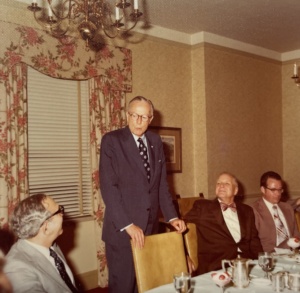
Fuller Jr. speaking at the Georgia Tech Research Institute meeting held at the Capital City Club in 1976. |
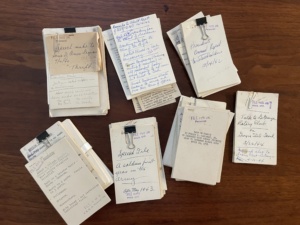
Fuller Jr. used small index cards for his speech notes. Some were handwritten while others were typed. |
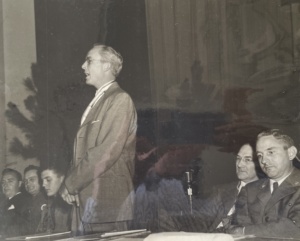
Fuller Jr. speaking at a Boy Scouts Silver Beaver Award Ceremony. |
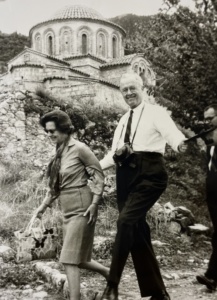
A tour of the archeological site at Mystras, Greece, was part of Fuller Jr. and Alice’s Mediterranean trip in 1967. |
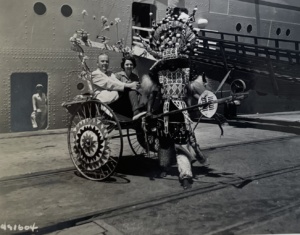
During their 1956 world cruise, Fuller Jr. and Alice enjoyed a traditional rickshaw ride in Durban, South Africa. |