The Honeybees Return
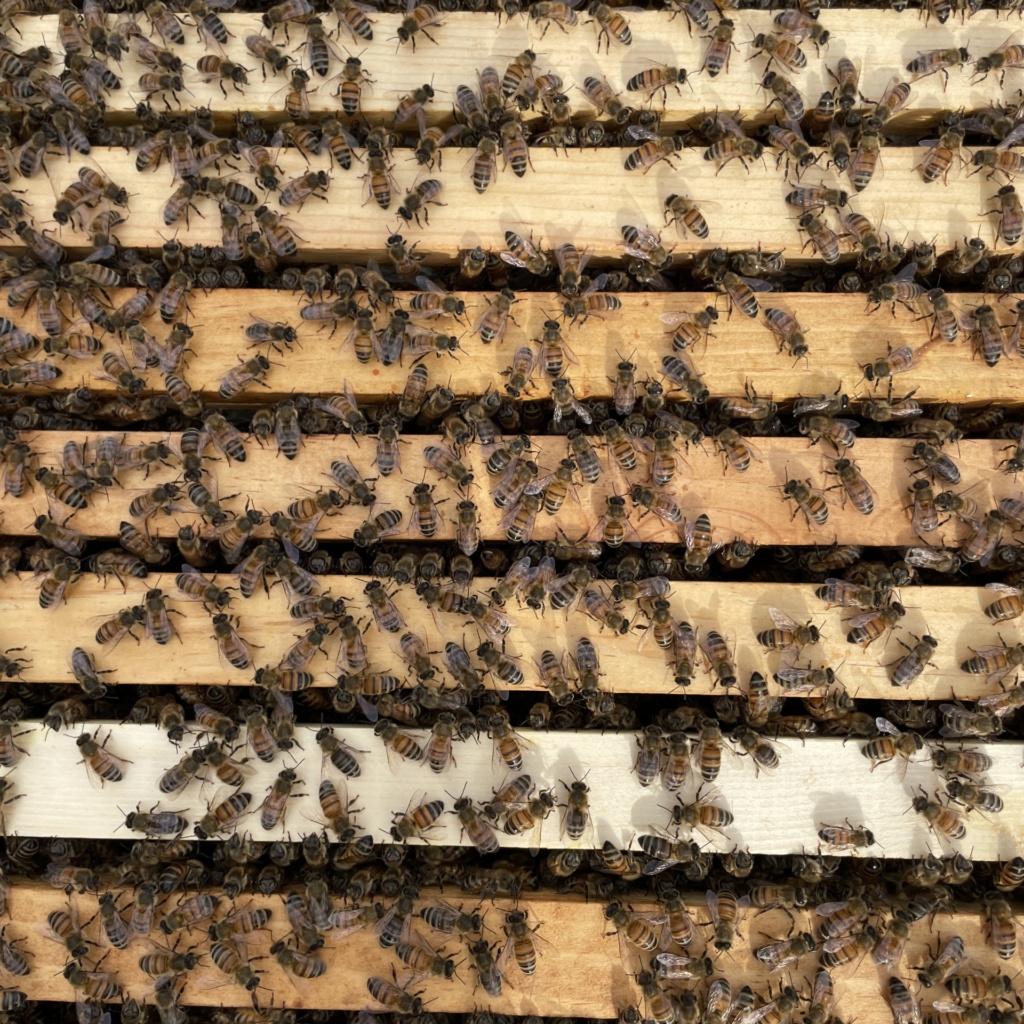
The Apiary
In the fall of 1945, Fuller Callaway Jr. began a decade-long sabbatical from his career in the textile industry, appointing Arthur Brannon Edge, Jr. to be his replacement, as president of Callaway Mills. Though definitely an uncommon practice in the mid-20th century business world, he chose to take the next ten years in the prime of his life (roughly ages 38-48) to focus his energies on hobbies he loved. One burgeoning area of interest was agriculture, even listing his occupation as “Farmer” on legal documents from that time. While his foray into raising Hereford cattle became legendary, Fuller’s penchant for agrarian pursuits, perhaps partly inspired by his brother Cason, extended beyond that. The acreage at Hills and Dales developed into much more than just a cattle ranch; it was a working farm where he explored forestry, oversaw sophisticated pasture management, planted orchards, and undertook growing vegetables. As he experimented and learned about cultivating the land, he also established an apiary for the husbandry of honey bees.
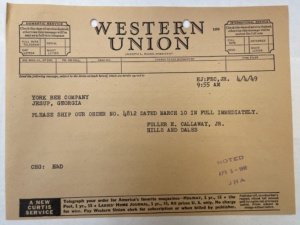
Mr. Callaway began his beekeeping enterprise in 1949 and, like most initiatives he approached, he was all in from the start. That March, he asked York Bee Company to send “…50 packages of three pounds each including queen all three band Italian disease free.” Later the same day he wrote: “I am today ordering hives for these bees from Paducah, Ky. and they probably will not be received until sometime next week….do not ship these bees until you receive a telegram from me that we have the hives ready for them.” So began his honey production efforts.
Aided by advice from W.E. Leverett from the Georgia Department of Entomology, and with David Bailey serving as the main beekeeper, the venture quickly prospered. Fuller noted: “our fifty beehives seem to be coming along very well. Some hives now have three supers in place…Approximately 25 of the supers…have been completely filled with honey and capped over.” By June, they were ordering equipment for extracting honey along with jars for storage. Later that year, Leverett provided advice and guidance when some of the hives appeared to be weakened by suspected, but unintentional, poisoning. Heeding his input obviously helped, as by 1951 they had expanded to 80 hives and were offering white clover honey for sale. Bailey continued overseeing the operation for 15 years, but for some unknown reason, Mr. Callaway decided to halt beekeeping at the estate in 1964. A note from his assistant, John Allen, reads: “We have sold all of our bee and honey equipment and all the bees…to Mr. Reimer of Sylvester, Ga.” With that sale, the Hills and Dales apiary was no more.
The Bee Team
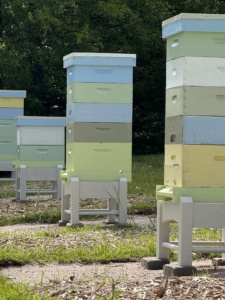
Fast forward to the present when, inspired by Fuller’s prior efforts and coupled with a desire to re-connect to the agricultural roots of the property, we jumped at the opportunity to bring honey bees back. Thanks to the volunteer efforts of Dick and Sydney Daniel and Zachary Taylor, an apiary was recently reintroduced on our grounds. Guests that take the tram from the Visitor Center up to the house and garden can now see a line of pastel-colored hives prominently standing on the terraced hill. Four colonies were initially established, captured either from swarms or hive splits within 2 miles of Hills and Dales. Ironically, a large colony was then relocated from a cutout performed at Elm City Mill, one of the earliest Callaway Mills. According to Dick: “The current mill owner saw the bees as a nuisance and wanted them removed, so we were happy to provide them a new home.” The latest came from one of the three trap boxes located on the estate. Right now, our hive count stands at six and, if all goes well, it will grow to twelve within the next year.
The “Bee Team”, as we call Dick, Sydney, and Zachary, is super excited to have an apiary located at Hills & Dales , noting in a collective voice: “Not only is it a wonderful home for the bees, but it also provides an educational platform where we can help people learn about the essential role these insects play in pollination. Just remember: without them pollinating flowers and food crops, our food supply would be seriously threatened. Bees truly are an essential part of the ecological food chain.”
Dick and Sydney Daniel have been working with honey bees for about ten years and are passionate caretakers. They got interested when their son Cheney gave them a hive as a Christmas gift. Zachary Taylor began his journey approximately three years ago when he decided to attend a Troup County Beekeeping Association meeting and became hooked. Since Dick is a professional builder, he and Taylor actually built each hive box and stand. They even painted them in pastel colors, a nod to Alice Callaway’s love of softer tones, creating a suitable aesthetic and making them stand out in the landscape. Think Charleston’s Rainbow Row-only for bees.
It’s easy to catch their fervor when the trio talks about queens, worker bees, and drones. They know all about their habits, behavior, and biology and use this knowledge to achieve healthier hives and produce more honey. Discussions revolve around adding supers and managing frames to create the ideal habitat, and at least once a week, one of them dons a beekeeping suit and veil to make sure all is well. They survey the hive, check the status of the queen, adjust the frames, expand or reduce the size of the colony, and inspect for the dreaded varroa mites.
Most exciting of all, by the time you read this story, the Team will have completed the first honey collection, being careful to leave enough for the bees to use in the fall and winter months. According to Dick: “We are essentially encouraging them to make more honey and if there is excess above their winter needs, we can have a fine harvest. If all goes well, we could gather 100 pounds from a single robust hive.” According to Taylor: “The ultimate goal is to deliver Hills and Dales-branded honey just like Mr. Callaway did. After all, it’s locally produced, absolutely delicious, and is naturally organic. A win-win for everybody.”
So, the next time you visit the estate make sure to look out for our colorful bee boxes; only keep your distance or risk getting stung by their amazing charm! ~CBW
Special thanks to Dick and Sydney Daniel, and Zachary Taylor for assisting with this article.
 |
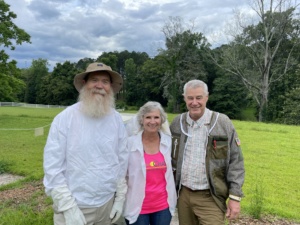
The “Bee Team: (Zachary Taylor, Sydney Daniel, and Dick Daniel) pose for a photograph next to the hives as they get ready to do a hive check. |
 |
 |
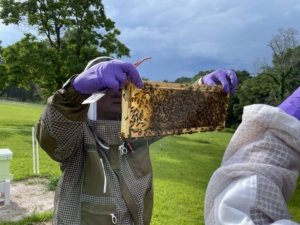
Dick Daniel carefully inspects a bee frame, looking for the queen. |