Renewal & Revitalization
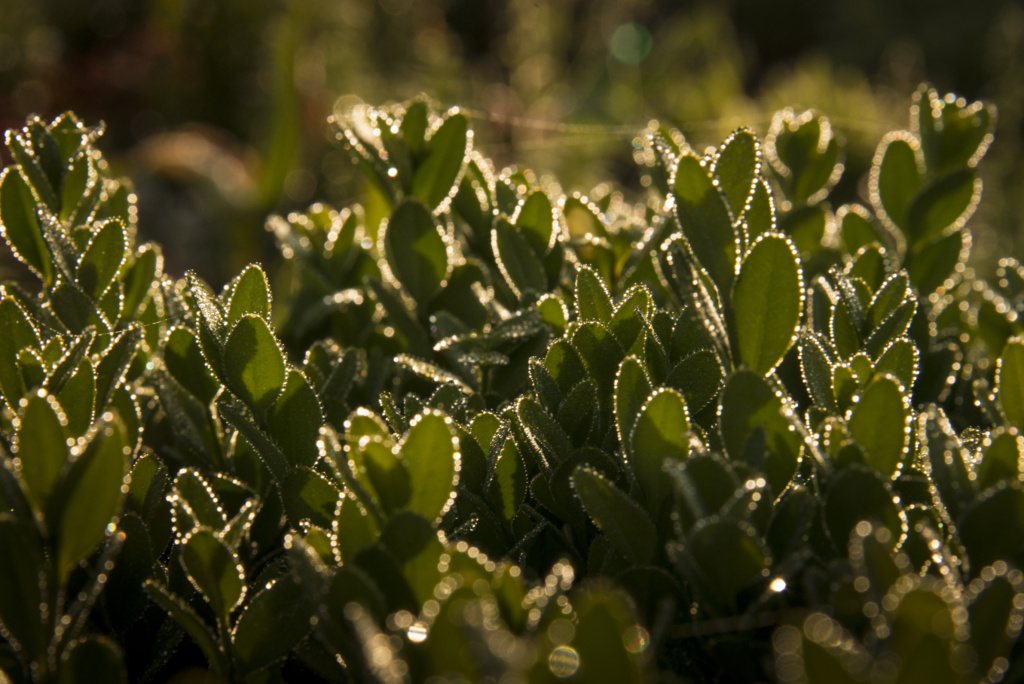
Would Sarah Ferrell recognize her garden today? Arguably, yes- because the most enduring element in the look of Hills & Dales (née Ferrell Gardens) is the boxwood on its terraces. Used to form hedges, parterres, and topiaries – the very structure of the garden – they appear timeless and are often perceived to be the actual shrubs planted by its designer, Sarah Ferrell; but there is great relief in knowing that not all the boxwood in the garden are original. In fact, it’s clear that even in some mature areas, replacements have been worked into its layout (conspicuous because they are visibly different species). All plants grow, mature and die eventually. This underscores something important: because a garden is a dynamic, living collection, resilience is the vanguard of proper care even in a historic setting.
In the early 1800s, the land that would become the garden was shaped by agricultural needs. Terracing was necessary to preserve topsoil on its slopes and work crops. Some of these remain today. When Mrs. Ferrell transformed the utilitarian landscape into a formal garden, she employed stone to fortify the terraces and mark the parterre shapes. These stones can still be seen in the garden and provide a useful guide for the preservation of her original designs.
What’s more, estate archives are full of images of the parterres clipped to be under knee-high. When caring for a noted, nearly 200-year-old garden, it can seem prudent to err on the side of caution when it comes to pruning, particularly with European boxwood. After a few years of this though, things can get misshapen, or so large that maintenance tasks become nearly impossible. Even dwarf varieties have grown to be 30” or taller. To take these old shrubs back down to an appropriate size, the garden’s team uses an incremental process that requires many months to complete. The sheer number involved makes that a daunting approach.
Overgrowth has been a problem in the evolution of the garden for some time, but now a relatively new threat, Boxwood Blight, has attacked. First seen at the Visitor’s Center in late 2020 and most recently on the 5th Terrace, this fungus has been quietly disfiguring the landscape. The Church Garden was hard hit and remained closed for several years in an effort to prevent the spread of the disease. Ironically however, this latter problem has provided the solution for the former.
Since 2011, when Boxwood Blight was first discovered in the U.S., scientists have been working hard to find treatments, and plant breeders got busy developing blight-resistant cultivars. The fruits of these labors are coming together at Hills & Dales. In the summer of 2024, the fungus set in for a long season of rampant spread, and many boxwood needed to be removed. Though sad and frustrating, this ultimately proved to be a golden opportunity to restore the garden by replacing them with resistant varieties also bred to stay small.
In addition, some researchers have had very positive results protecting un-infected boxwood by treating with a fungicide drench in the root zone of the plant. The fungicide is taken up into the shrub through the roots, and it persists in the tissues for 2+ years. This is great news for our larger American box that haven’t shown any symptoms, and a treatment was applied here just before Thanksgiving ‘24.
If you’re thinking “two birds-one stone,” you’d be half right. Because of the need for renovation, at least 4 persistent problems can be corrected. In addition to addressing the size and disease issues, we can also use a set of 1936 diagrams from our archives to reset those guide stones Sarah Ferrell placed around the parterres. Over the years, some have been moved by falling trees or growing roots, altering the shapes. The fourth and final improvement is soil enrichment. After nearly 200 years of raking leaves and competing root systems, nutrients and organic matter have been depleted. With each restored planting, humus-laden compost is liberally worked in, further setting the new shrubs up for success.
Though the outbreak of Boxwood Blight started out as a threatening blow to the garden, it has now been reshaped into an opportunity for its healthy renewal, allowing the horticulture staff to use science and stewardship as the dynamic duo of caretaking at Hills & Dales. We look forward to sharing its ongoing revitalization with you. ~VV
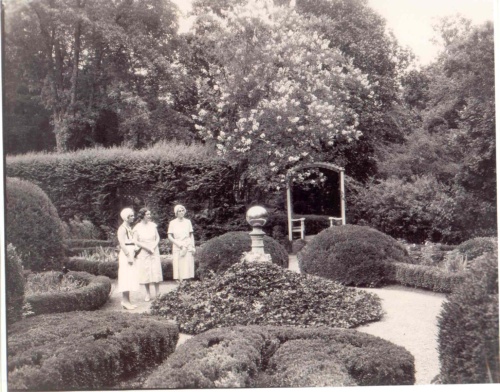
Visitors in the garden, circa 1930 |

Fuller Sr. giving a tour of the garden to some friends, circa 1916. |
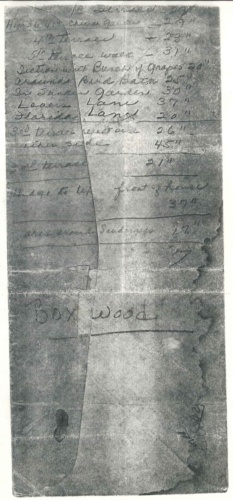
At some point, Alice Callaway measured the heights of the boxwood hedges at Hills & Dales and wrote them down on the back of an envelope in pencil. She must have had a sudden urge to record the dimensions since much of her other documentation is on lined paper or typed. |
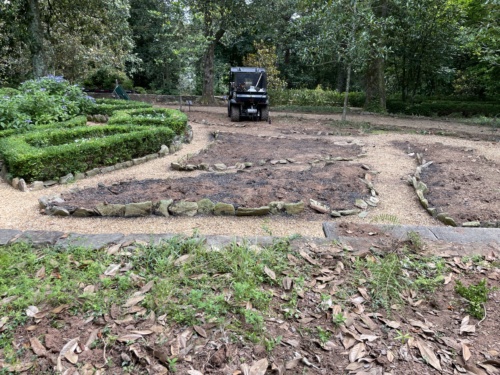
Boxwood removal in the maze area shows the original guide stones. |