Collection Corner: Plan No. 1143
“One of the greatest satisfactions I have had in my practice of landscape architecture over the years has been for some of my clients to tell me how they have enjoyed the gardens that I have planned for them.” John Leon Hoffman, 365 Happy Days in the Garden: Garden Calendar & Guide (1950)
Following Ida Cason Callaway’s death in April 1936, her youngest son Fuller Jr, his wife Alice, and their two children moved into the family home at Hills & Dales Estate. In a 1994 interview, Alice revealed she had been “frightened beyond words” at the thought of caring for the 13,000 sq. ft., 1916 Neel Reid designed home, as well as the historic formal boxwood garden originally created by Sarah Coleman Ferrell in the mid-1800s.
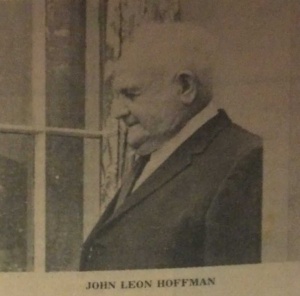
As the garden’s new caretakers studied the property, they noticed how some of the plants put in by Sarah and Ida had overgrown their current locations and that some cleanup was needed. The couple took action first by contacting noted civil engineer and landscape architect John Leon Hoffman, of Atlanta and Forsyth, to devise a plan to revitalize the garden. For his education and training, Hoffman had followed in his father’s footsteps and attended Alabama Polytechnic Institute, later renamed Auburn University. There, he majored in botany and horticulture before studying engineering at Massachusetts Institute of Technology (MIT) in Boston. He had previously worked under George H. Miller, who designed the city of Fairfield (formerly Corey), Alabama, for U. S. Steel Corp., and oversaw the development of Druid Hills for the Candler family in Atlanta before establishing his own company in 1914. He went on to do extensive work in both Georgia and Florida and, most notably for this area, for Cason J. Callaway at Blue Springs, Callaway Gardens, and his LaGrange home near Hills & Dales.
One of Hoffman’s interests was native plants. His 1949 book, The South: The Land of Flowers, expanded on his father’s nearly 50 years of work with the region’s indigenous species. In a 1955 letter to Cason, he explained that these plants are “more beautiful because they are in their native state with backgrounds that harmonize.” After bidding on the LaGrange-Troup County General Hospital landscape proposal in 1936, Building Project Chairman H. H. Childs remarked that he was “especially impressed with [Hoffman’s] basic idea of the proper approach to a job of this kind, namely, that of working WITH nature instead of indulging in artificialities.”
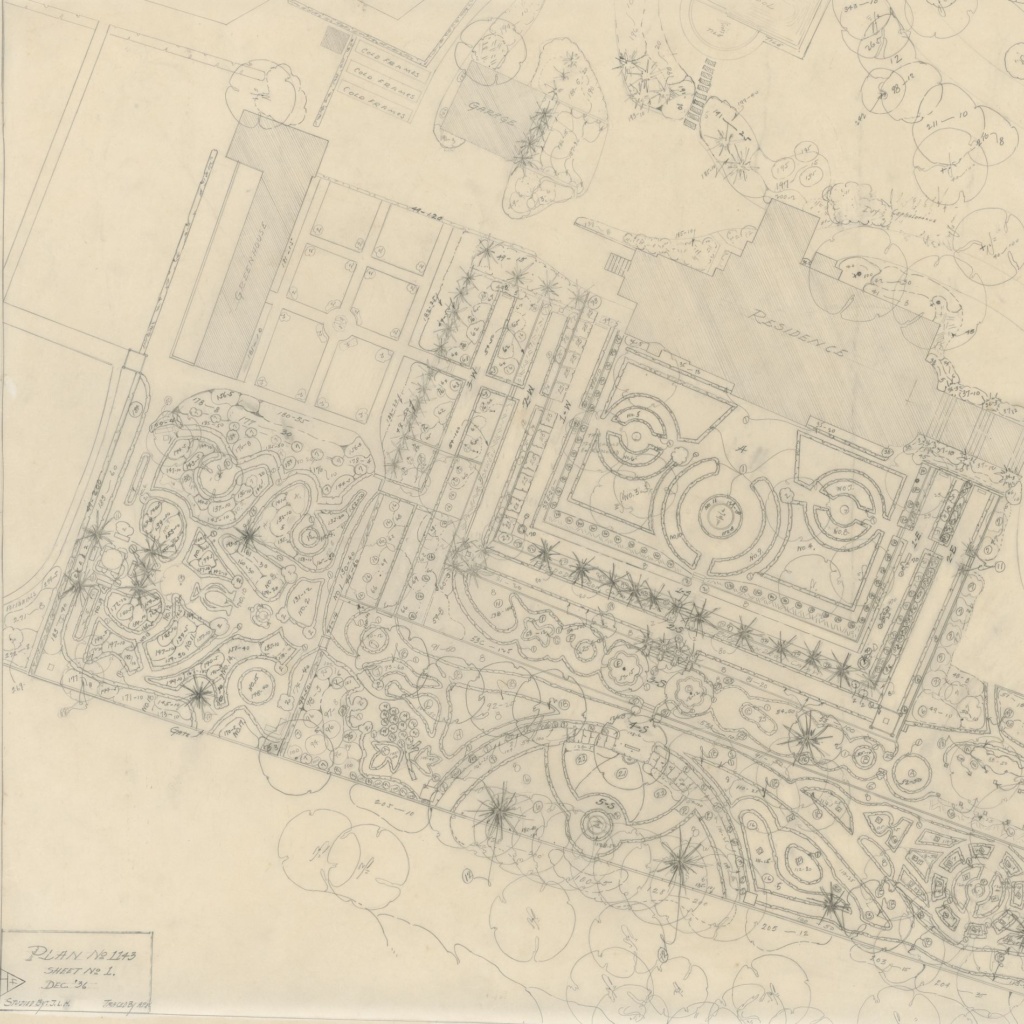
His plan for Hills & Dales, numbered 1143, was completed in December 1936. The project included 10 detailed hand-done drawings of the gardens and a 36-page document titled “Specifications and Plant List for Hills and Dales, Mr. and Mrs. Fuller E. Callaway Jr., LaGrange, GA.” In it, Hoffman wrote that “during the many years past the owners were so devoted to every twig and sprout in the garden that undue advantage was taken by many of the trees and bushes in growing-up – overshadowing and sapping the life out of valuable plants.” His plan to get the historic garden “back in order” gave bed-by-bed directions for every area and included removing or replacing plants, adding a new drive, and grading parts of the terraces to make a continuous slope from the home to the stream. Fertilization recommendations, pruning schedules, and maintenance instructions were also added as further guidance.
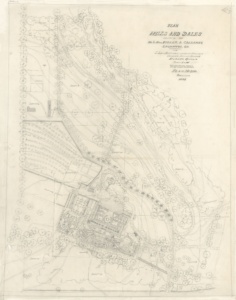
Hoffman’s drawings included a large aerial map of the estate, which was then broken into 9 smaller sections called “Sheets.” The sheets depicted more details than the aerial map of the estate, including the species that should be in each section. Done in an almost paint-by-number format, the numbered botanical stencils on the drawings correspond to the “Key Plant” listing. While it’s hard to tell if Alice and Fuller followed Hoffman’s suggestions exactly as written, there is evidence that they did complete portions of the proposal. One example that today’s guests can see is the portion of the historic terraces that were plowed down into a smooth hillside from the Callaway home to a small white bridge as they tram up to the garden for tours.
Earlier this year, Horticulture Manager Valerie VanSweden made high-resolution scans of Plan Number 1143. Her goal is to use them to create a preservation base map, which will help to inform future garden decisions and projects. The next time you stop by for a visit to Hills & Dales, we hope you remember these eloquent words from Leon Hoffman: “It is in the garden that one expects to find a closer communion with his Creator and a peace of mind that can be found in few other places, for it is thought that life itself originated in a garden.” ~HM
 |
 |